scheller edvAI ARCHITECTURE & DELIVERY Discuss your project
info@scheller-edv.de

FROM EXPERIMENT TO PRODUCTION

AI that works
in your business.
Not just in demos.

I help you find out where AI pays off, and I take the applications that make sense safely into production: connected to your processes, data and existing systems.

No AI for AI’s sake. Problem and value first, then technology.
Andreas Scheller, consultant for AI architecture and software developer
Andreas SchellerAI architecture, integration & delivery
25+years of software
running in production

Experience from projects for mid-sized companies, industry and corporations.

References from more than 25 years
  • ZEISS
  • HUK
  • SAXOPRINT
  • PFAFF Industrial
  • digitech.eu
  • ROPA
  • CANOTIS BOS AG
  • kardex
  • EPG
  • E.ON
  • Continental
  • VOITH
  • Stadtwerke Heidelberg
  • SIEMENS homes
  • SSI
  • GEA
  • KRONES
  • Syskron
  • Universitätsklinikum Regensburg
  • ORGADATA AG
  • WERBAS//KSR
  • ITSV

WHERE I CAN HELP

The demo impresses.
Daily business decides.

ChatGPT, Copilot and the first agents are quickly rolled out. The real work starts afterwards. Do you recognize one of these situations?

  1. “Where does AI really pay off for us?”

    You don’t want to introduce yet another tool. You want to know which process actually improves. We start with the problem and do the math before technology comes into play. “This doesn’t need AI” is a valid result, too.

    Where to start: AI Impact Check
  2. “We’ve already built something.”

    A prototype, an agent or a workflow, built with Claude, Copilot or n8n. Good: then we don’t start from scratch. Together we review what is ready for production and what still needs to be secured.

    Where to start: Prototype Check
  3. “Our AI pilot isn’t making it into daily work.”

    Your AI can answer. Can it also work with your company? I connect it to your data, processes and existing applications: with approvals in the right places and without an unnecessary rebuild.

    Where to start: Blueprint & Implementation Sprint
  4. “Our team builds with AI itself.”

    And it should. To keep this from turning into uncontrolled sprawl, your team gets a clear software architecture, standards and guardrails that let it work fast and under control.

    Where to start: AI Architecture Advisory

A THOUGHT EXPERIMENT

Both use the same AI.
Only one wins the order.

Monday, 8:17 a.m. Two companies receive the same request: a customer needs a replacement by Thursday for a part that is no longer available.

Replies after one minute.

8:18 a.m.
“Thank you for your request. We will gladly look into an alternative.” Well worded, friendly, fast.
After that
Three employees piece together the order, the documents and the availability. A special requirement of this customer isn’t in any of the documents they have open.

The AI sped up the email.
Not the process.

Replies after two hours.

Weeks before
The question wasn’t “Which AI should we buy?” but “Why does a reliable answer take us so long?” The information was there. It was just in different places.
10:20 a.m.
A verified offer: a suitable alternative, the available quantity, a confirmed delivery date. Missing details were made visible, and an employee approved it.

The customer orders.
Their work can go on.

The order didn’t go to the better AI.

It went to the company that could turn its information into a reliable commitment faster.

And what if company A catches up?

Then both reply quickly, and speed alone no longer sets anyone apart. That is why the question “Where can we use AI?” isn’t enough. The more important one is:

“When the others catch up: what remains your good reason to be chosen?”

That is exactly what we clarify first. Sometimes it takes AI. Sometimes a clean interface is enough. Sometimes the process has to be sorted out first.

Start with the AI Impact Check

The example is fictitious and serves as an illustration.

OFFERS WITH A CLEAR RESULT

Start small.
Decide with evidence.

No open-ended hourly account to begin with: every step has a fixed scope and a tangible result. After that, you decide whether we expand, change course or stop.

Find the right starting point
  1. Problem
  2. Process
  3. Value
  4. Architecture
  5. Technology

In this order. Not the other way round.

Scope and price are fixed before we start.
A well-founded “stop” is a good result, too.

01

ANALYSIS · FIXED PRICE

AI Impact Check

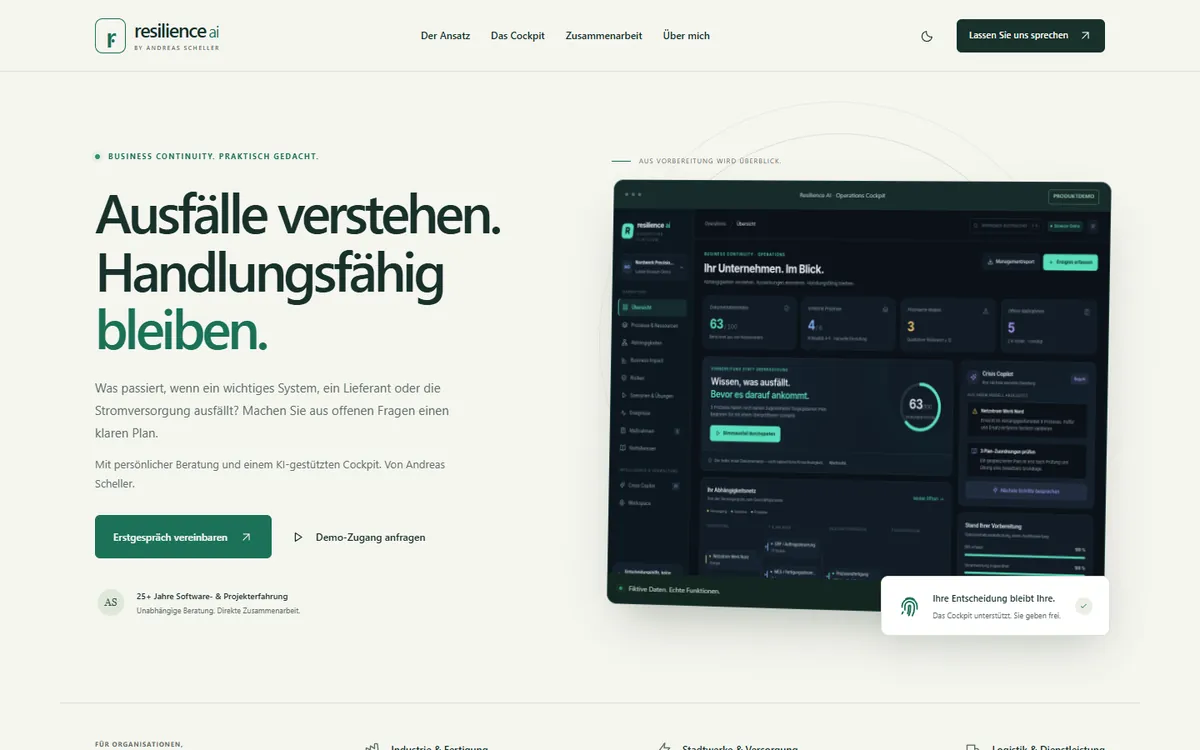
One specific process, one verifiable benefit, one well-founded decision. In a few workshops we clarify where AI pays off for you and where it doesn’t.

Your result: A prioritized assessment with business case, risks and the simplest solution that makes sense.

Request the AI Impact Check
02

ANALYSIS · FIXED PRICE

Prototype Check

For applications, agents and workflows you have built yourself. I review architecture, security, data and data protection, quality of results, costs and operations.

Your result: A clear statement on production readiness and a concrete action plan.

Request the Prototype Check
03

DESIGN & IMPLEMENTATION

Blueprint & Implementation Sprint

For one selected use case: first the target architecture, then the implementation within a few weeks. Built by me or together with your team.

Your result: A solution that runs in your systems: tested, monitored and properly handed over.

Discuss implementation
04

ONGOING SUPPORT

AI Architecture Advisory

I support your AI architecture on fixed days each month: roadmap, architecture decisions, reviews and guardrails for your team.

Your result: One dedicated contact who holds your AI initiatives together technically.

Request advisory support

OWN PRODUCTS & INSIGHTS

Not just advice.
Built, too.

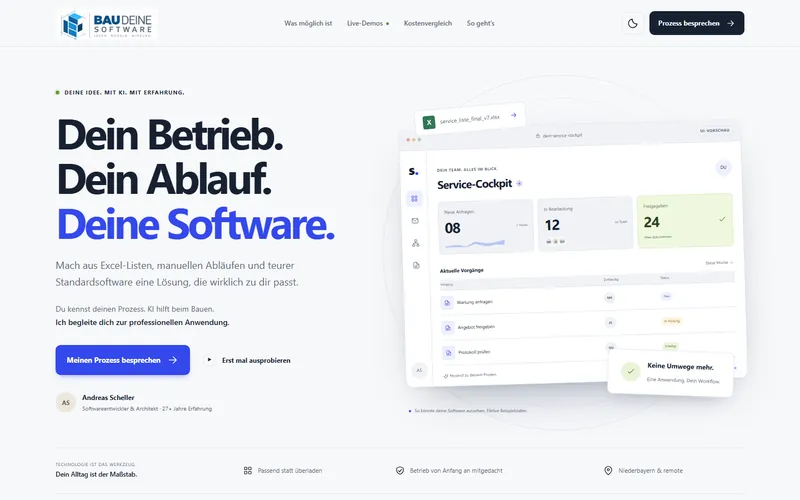
My own products and offerings. They show how I approach solutions: starting from the problem and built by myself.

ADVISE. DESIGN. DELIVER.

I’m
Andreas Scheller.

Neustadt an der Donau, Bavaria, Germany

25+

years between
code and clients.

With AI, I care less about the demo
than about whether it holds up in daily work.

I come from more than 25 years of hands-on software development and software architecture: legacy systems, rollouts, unclear requirements and users who use software differently than planned. That is why I think about AI from the perspective of operations, not of the presentation.

My role sits between management, business departments and IT. I talk to you about business value, to the departments about processes, to data protection about data and to your developers about interfaces. And where it makes sense, I build the solution myself.

This is how I close the gap between consulting that doesn’t build and demos that underestimate everyday business. You work directly with me: from the first question to the handover.

Professional Scrum MasterProduct Owner · SPOACCAS genesisWorld Certified Developer

.NET / C# · JavaScript · Cloud · APIs · Databases · LLMs · RAG · Agents · Automation

Mostly remote · On site by arrangementConnect on LinkedIn

Less AI slop.
More substance.

By AI slop I mean results that look finished quickly but pass their quality problems on to the next colleague or to the customer. A quick draft is valuable. It becomes a problem when nobody distinguishes between a draft and a reliable result anymore.

  1. Impact over output volume

    I look at the whole process, including review, follow-up questions and rework. Not at how much an AI produces.

  2. Traceable, not just plausible

    Important statements have identifiable sources. Missing information and limits become visible instead of being glossed over.

  3. Governed, not left open

    It is defined what a solution may do on its own, when a human reviews and who acts when problems occur.

And we agree beforehand how we will recognize a good result. You don’t have to take my word for quality. You can verify it.

THE FIRST STEP IS A CONVERSATION

What should work
better for you?

Tell me briefly where you stand: with an idea, a pilot or a solution you built yourself. I will get back to you personally. In a free initial call we clarify your situation and a sensible next step.

30 minutes Personally with me No obligation

I use your details only to answer your inquiry. More in the privacy policy.